
Is This What I'm Looking For?
Use this article when you need to correct inventory counts from the warehouse floor, for example after damaged product, a cycle count, or a customer audit. You can enter the new total, or enter only the number of units you're adding or removing. Without an accurate count, InfoPlus can allocate inventory that isn't really there or hold up orders that could otherwise ship. This article covers the mobile app. If you're at a desktop instead, see Create Quick Adjustments.
Before You Begin
- Permission level: Requires access to the Inventory Adjustment table and Inventory Adjustment on the Warehouse Apps.
- Prerequisite: InfoPlus provides a few default adjustment codes out of the box. Add your own as needed with Create and Edit Adjustment Codes.
- Prerequisite (if scanning by case, pallet, or inner pack barcode): These barcode fields are turned off by default. Go to the Warehouse table, then the Item Barcode Fields tab, and turn them on first.
- Materials on hand: A mobile device with the InfoPlus App installed, and the item's Location, SKU, or Product ID Tag ready to scan or enter.
Steps
- Log into the InfoPlus App
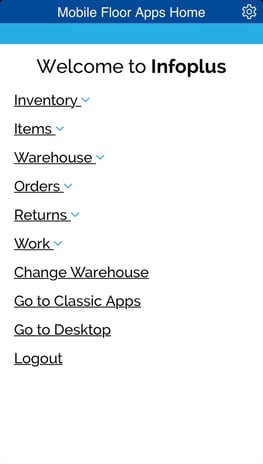
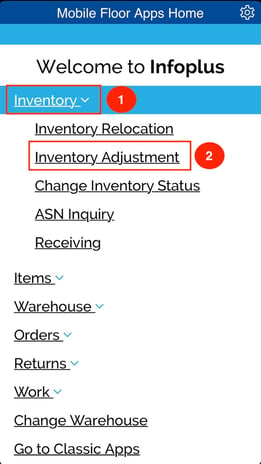
- Select Inventory → Inventory Adjustment. Select the Warehouse if needed.
- Enter or scan the Location, SKU, or Product ID Tag.
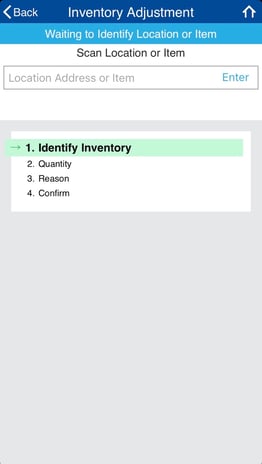
- Identify the item or Location.
If more than one location or item matches, select the correct one from the list. You can also choose a past location the SKU lived in during the last 30 days (Past Inventory Location), as long as a different item that can't mix with this one hasn't been placed there since.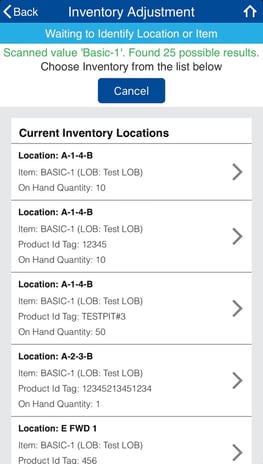
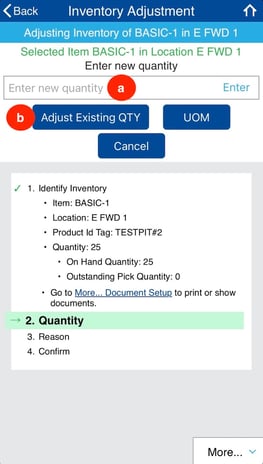
- Enter the Quantity for the item and location in one of two ways.
- To enter the new total: Type it in the Enter new quantity field and tap Enter. For example, if there were 5,000 items in the location and 100 were damaged, enter 4,900.
- To enter only the change: Tap Adjust Existing QTY. Type the change in the Enter Adjustment Quantity field and tap Enter. Using the same example, enter -100. To add units, enter a positive number.
- Select a Unit of Measure (UOM), if needed.
If the item has a UOM set up, select the UOM button to adjust by Pallet, Case, Inner Pack, or Eaches. If UOM barcodes are set on the item, scan the barcode instead.
If you tapped Adjust Existing QTY, the Total Quantity on the UOM screen is the number of units you're adding or removing. It isn't the new total.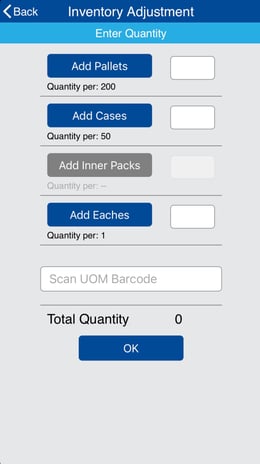
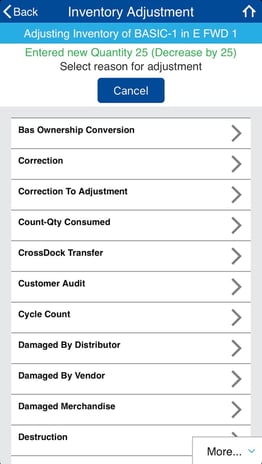
- Select a reason for the adjustment. The green text across the top of the screen shows the new quantity and the change, for example "Entered new Quantity 13 (Increase by 5)." Confirm it before you select a reason.
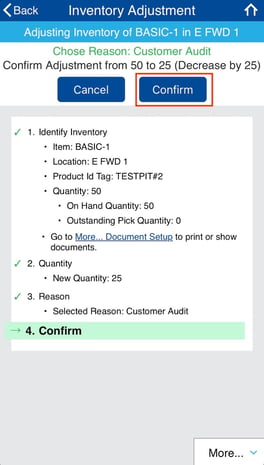
- Review the Confirmation screen, then select Confirm.
What You Should See
The app shows an adjustment confirmation message and is ready for your next adjustment. The change applies to the on-hand quantity in that location. On the desktop, the Inventory Adjustment table shows a new row with the adjustment information, including the before and after quantities.
Troubleshooting
If you can't search by Case, Pallet, or Inner Pack barcode:
Why this happens: These barcode fields are off by default.
How to fix it: Go to the Warehouse table, then the Item Barcode Fields tab, and set each field to True.
If you see "[value] is not a valid number":
Why this happens: When you enter only the change, the quantity accepts whole numbers only. Letters and decimals aren't accepted.
How to fix it: Enter a whole number. To remove units, put a minus sign in front, like -100.
If you see "To decrease quantity, enter number less than current known total":
Why this happens: A number greater than the current quantity was entered. You can't make the quantity be negative.
How to fix it: Enter a quantity less than or equal (≤) to the current known total.
Next Steps
- If you need to create or edit reason codes, see Create and Edit Adjustment Codes.
- If you're not on the warehouse floor, see Create Quick Adjustments to adjust inventory from the desktop app.
- If you need to move inventory instead of changing its quantity, see Relocate Inventory.
